Introduction
Every year, the same headlines appear declaring that cold email is dead.
Critics argue that inboxes are overflowing, spam filters are impenetrable, and the tactic is “100% dead”.
But the data tells a different story.
The truth is that lazy cold email is dead.
In 2026, cold email remains one of the most powerful strategies for B2B growth—provided you stop “spraying and praying” and start treating it as a precision tool.
Here is why cold email is not only effective but essential in the current landscape.
1. It Is the Most Cost-Effective Channel
While paid marketing channels are becoming prohibitively expensive, cold email offers a significantly higher ROI.
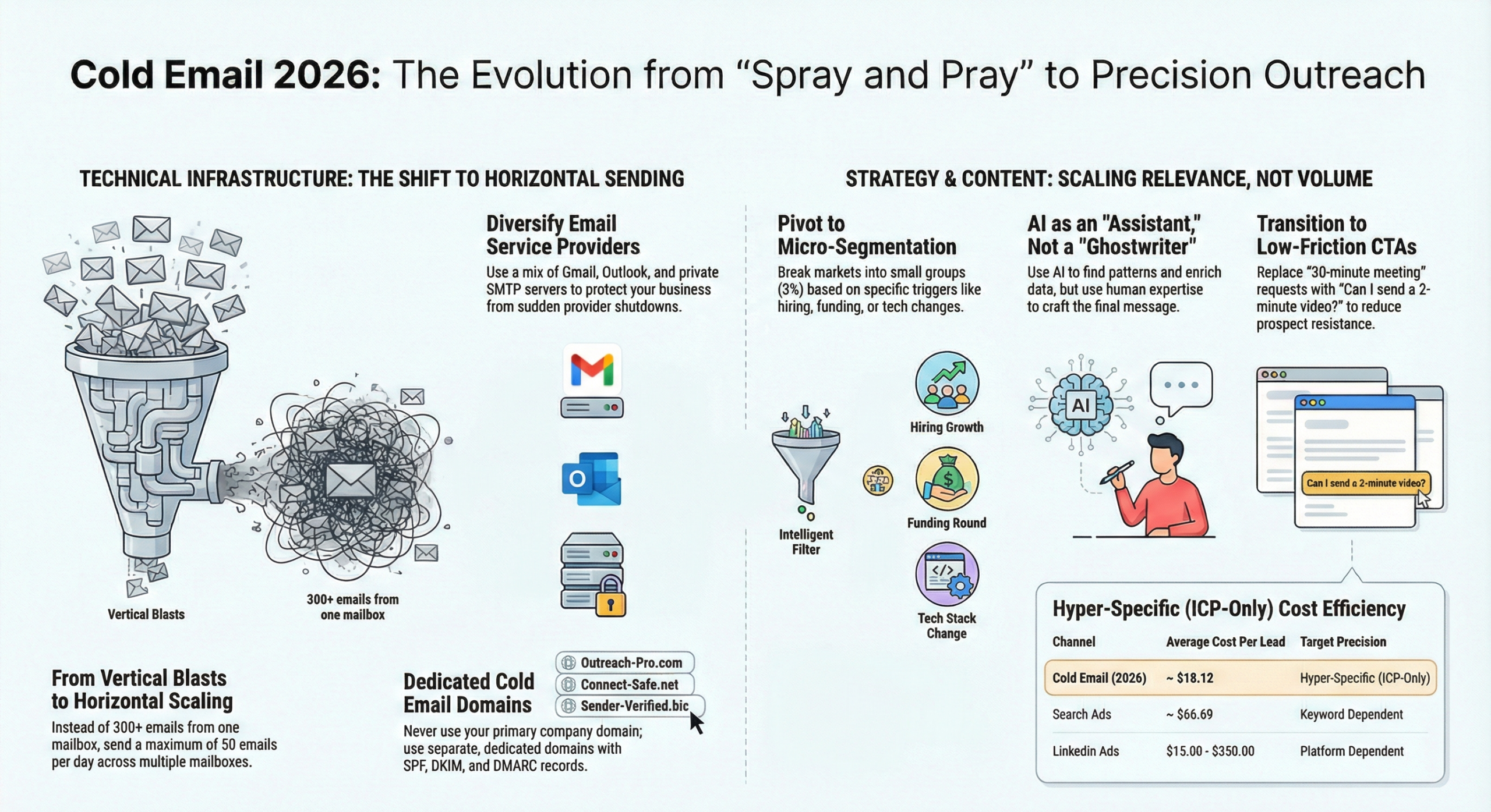
Recent benchmarks show that the cost per lead for LinkedIn ads can range from $15 to $350, whereas cold email can drive leads for as little as roughly $18.
Unlike ad auctions where costs rise with competition, cold email costs remain stable.
For a standard subscription, you can contact thousands of prospects, making it accessible even if your deal size starts as low as $1,000.
It is a simple, scalable way to reach target customers without paying a premium for every click.
2. Relevance Has Replaced Generic “Personalization”
The days of faking familiarity with a “Just touching base” or “I hope this finds you well” are over.
These generic templates are now ignored or filtered out.
In 2026, effectiveness comes from micro-segmentation.
Instead of blasting 10,000 contacts, successful senders focus on the “right 3%” of their market.
By using advanced data enrichment, you can build detailed segments based on specific triggers, such as a company hiring for a specific role, raising funding, or changing their tech stack.
When you target a prospect based on a business change rather than a demographic trait, your message transforms from an interruption into an interception.
You aren’t just selling; you are solving a timely problem.
3. It Is the Only Channel You Own
Social media algorithms change constantly, and gatekeepers can block phone calls, but email remains a direct line to a decision-maker.
It is a channel where you control the volume, the targeting, and the narrative.
Furthermore, cold email acts as a conversation engine. Even a “no” provides valuable first-party data that helps you refine your positioning and pricing in the real world.
4. The Infrastructure Has Evolved
A major reason people fail at cold email today is that they are using 2015 tactics in a 2026 environment. To succeed now, you must adopt horizontal sending.
Rather than sending hundreds of emails from one address, the new standard is to send low volumes.
Approximately 50 emails per day, across multiple mailboxes and domains.
This approach mimics human behavior and keeps your sender reputation high, ensuring you land in the primary inbox rather than the spam folder.
5. AI Is the Assistant, Not the Writer
While AI is prevalent, using it to write your entire script often results in robotic, disconnected copy.
The most effective deal-closers use AI for research and segmentation—finding patterns and clusters in data—while retaining a human touch for the actual messaging.
The goal is to balance scalability with a genuine, human voice.
How LeadSlot Can Power Your 2026 Strategy
If you are ready to implement a modern, high-precision cold email strategy, LeadSlot provides the all-in-one infrastructure you need to scale.
LeadSlot helps you move beyond the “spray and pray” method with features designed for 2026:
• Access 450M+ Verified Leads: Stop wasting time on bad data. Search a massive database of verified B2B contacts to find your perfect ICP.
• Smart Personalization: Utilize an AI-powered engine that customizes every email based on recipient data to significantly boost your reply rates.
• Automated Intelligence: Set up drip campaigns with intelligent follow-ups and optimize your send times automatically.
Don’t let outdated tools hold back your growth.
[Start your free 14-day trial with LeadSlot today] and turn cold outreach into warm conversations.